Naar de inhoud van de pagina

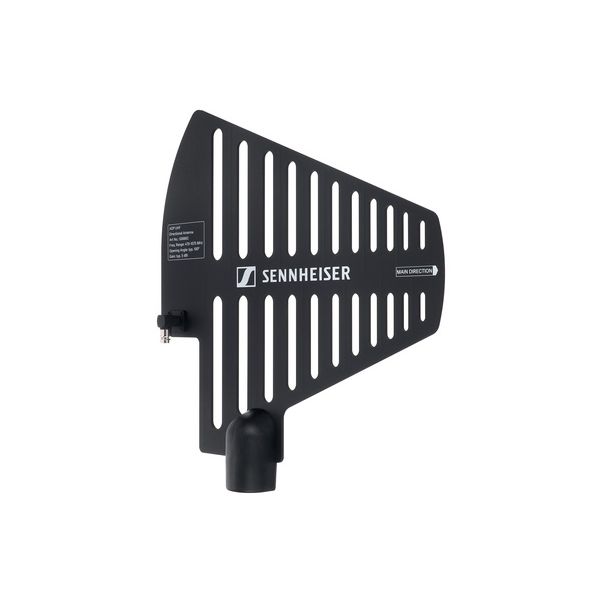
Sennheiser ADP UHF 470-1075 MHz B-Stock

B-Stock met volledige garantie
Geretourneerd product met mogelijk lichte gebruikssporen

Passieve externe directionele antenne

  • UHF-bereik: 470 Hz - 1075 MHz
  • BNC aansluiting
  • 3/8" en 5/8" Schroefdraad voor microfoonstatieven
  • Leverbaar sinds Juni 2021
  • artikelnummer 565366
  • verkoopseenheid 1 stuk
ook als nieuw beschikbaar. € 369
€ 339
Alle prijzen incl. btw
Direct leverbaar

Secure connection, effortless setup

The Sennheiser ADP UHF is a passive external directional antenna designed for operation within the 470MHz to 1075MHz UHF frequency range. It enhances the performance and reliability of Sennheiser's Evolution Wireless systems, ensuring stable transmission even in demanding environments. A female BNC connector with a bayonet coupling ensures a secure connection, while adherence to the 50-ohm standard guarantees high power transmission and minimal signal loss when using coaxial cables. Two integrated threaded inserts allow for quick and easy mounting on any standard microphone stand.

Sennheiser ADP UHF 470–1075 MHz – angled full view

Wide coverage with flexible placement

The Sennheiser ADP UHF directional antenna is engineered for accurate, stable signal reception across a 100-degree coverage angle, offering both flexibility in placement and reliable performance even at shorter distances. This wide pickup range makes installation straightforward while providing performers with maximum freedom of movement on stage. Built for professional applications, the ADP UHF combines technical efficiency with visual subtlety. Its sleek black finish and fin-style housing – measuring approximately 32 by 31cm – blend seamlessly into any production environment, ensuring optimal functionality without drawing attention to the hardware.

Sennheiser ADP UHF 470-1075 MHz Detail

For Evolution Wireless users

The Sennheiser ADP UHF enhances the performance and range of digital receivers from the Sennheiser Evolution Wireless series. Its reception range covers multiple frequency bands, including Q1-6, R1-6, R4-9, S1-7, S7-10, and U1/5, ensuring broad compatibility across professional setups. It also integrates seamlessly with the ew-D AB antenna booster, providing additional signal strength and reliability, while users of the ew-D ASA active antenna splitter can connect multiple ADP UHF units for expanded configurations. With its modular, future-proof design, the ADP UHF allows Evolution Wireless users to scale and optimise their systems for any environment, from stage to studio, with maximum flexibility and confidence.

Sennheiser ADP UHF 470-1075 MHz Detail Logo

About Sennheiser

In June 1945, Prof. Fritz Sennheiser founded the Wennebostel Laboratory, which initially produced measuring equipment. Commissioned by Siemens in 1945, the young company developed the MD-1 microphone, which was launched in 1946. After the development of further microphones, the company was renamed Sennheiser Electronic in 1958. Two years later, Sennheiser introduced the MD 421 dynamic microphone, which is still in production today and still held in high esteem by many sound engineers. Further groundbreaking developments, such as the HD 414 headphones and the classic MD 441 microphone, hugely enhanced the company's international reputation, eventually making Sennheiser one of the leading manufacturers of microphone and headphone systems in the world.

Enhanced range and reliability

The Sennheiser ADP UHF extends the operating range of wireless systems while improving their reliability and scalability. For optimal performance, the antenna should be positioned at least 50cm away from nearby walls, and when using two passive antennas, a minimum distance of 1m should be maintained between them. To ensure stable transmission, performers using handheld or bodypack transmitters should ideally remain more than 1.5m from the antenna. When used as part of a mobile wireless setup rather than a fixed installation, the antenna's 1.1kg weight becomes an important consideration – particularly when multiple units need to be transported.