


Rode RodeCaster Video S B-Stock

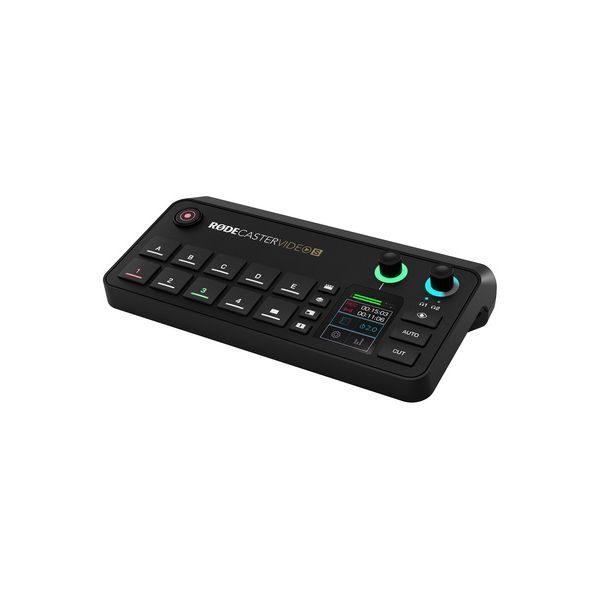
RodeCaster Video S
Video and Audio Production Console
- Switch between up to 4 video sources and 5 scenes
- Automatic standard conversion on all HDMI and USB inputs
- RTMP streaming via Ethernet or Wi-Fi
- Recording to external USB storage or via UVC
- ISO recording from 4 video sources
- NDI support via Ethernet
- Integrated media player with 24 GB memory for MP4, PNG, JPG, WAV
- 2 downstream keyers, 2 chroma keyers and 1 luma keyer
- Aphex audio processing: compressor, EQ, stereo panorama, de-esser, high-pass filter, exciter, big bottom, compellor
- Bluetooth 5.3 for stereo sources and phone calls
- Integrated receivers for two Rode wireless microphones
- Ultra-low noise Revolution preamplifiers with up to 76 dB gain
- Controls: 5 scene buttons, 4 source buttons, Record, Auto, Cut, 6 function buttons (Fade to Black, Media, Overlay, Multi Source, Keying, Inspect)
- Auto-switching for camera and scene changes
- 2" touchscreen
- 2 switch/encoders: one multifunctional for programs, one for volume (controlling headphones 1 and 2 separately)
- Remote control via free RodeCaster app (Mac/PC)
- Inputs: 3 x HDMI
- Output: HDMI
- Mic/Instrument/Line inputs: 2 x XLR/6.3 mm jack combo
- Stereo headphone outputs: 2 x 6.3 mm jack
- 3 x USB-C ports for computer/portable devices
- USB-C for saving to external hard drives and devices
- Ethernet port
- Power supply via USB-C (external PSU included)
- Dimensions (W x D x H): 254 x 129 x 61 mm
- Weight: 875 g
- Includes power supply unit and USB-C cable
-
Leverbaar sinds Januari 2026
-
artikelnummer 635064
-
verkoopseenheid 1 stuk
Why buy two devices when one's enough?
The Rode RodeCaster Video S is a compact all-in-one console combining video switching, broadcast-style audio processing, and integrated wireless reception in a single desktop unit. It's a more compact variant of the RodeCaster Video, sharing the same production philosophy in a smaller footprint, and also designed and manufactured in Rode's Sydney facility. An octa-core CPU handles simultaneous video and audio processing, supporting up to four video sources, five recallable scenes, and nine stereo audio channels at once. For solo creators and small production teams, the combination of video switching, professional audio, and direct streaming in one device removes the need for separate dedicated units and the signal routing complexity that comes with them. At 875g and 253.5×128.4×60.2mm, it sits comfortably on a desktop without dominating the workspace.

)
Audio and video in one
The RodeCaster Video S accepts three HDMI inputs, a USB-C port for webcams or Rode USB audio devices, and four NDI inputs for network cameras, and outputs a combined signal at up to 1080p/60fps. Up to five scenes can be stored and recalled instantly, while auto-switching changes the active camera based on audio input detection. On the audio side, nine stereo channels are available simultaneously from up to 18 possible sources – two Neutrik XLR combo inputs with Revolution Preamps (76dB gain, -131.5dBV EIN), two built-in Series IV wireless receivers, HDMI audio, Bluetooth 5.3, and USB audio sources. Two headphone outputs on 6.35mm jacks allow independent monitoring. Streaming goes directly via RTMP over Wi-Fi 6 or Gigabit Ethernet to YouTube, Twitch, Facebook, and other platforms, while recordings – including separate ISO source tracks – save to external USB storage.
)
Less setup – better results
The RodeCaster Video S suits solo creators, video podcasters, corporate comms teams, and small production companies who need a unified A/V system for interviews, explainer content, and live streams. Per-channel Aphex processing – including EQ, compression and noise gate – means audio can be shaped independently for each presenter, which is especially useful in multi-participant setups where voices vary significantly in level and character. A clean, repeatable workflow matters more here than 4K output – the four-source video limit and 1080p ceiling are the trade-offs; for productions requiring more video inputs, higher resolution, or highly complex broadcast audio routing, the larger RodeCaster Video is the appropriate step up. For its intended context – up to four participants, multi-angle switching, simultaneous streaming and recording – the feature set is well matched to the task.
)
About Rode
Founded in Sydney, Australia in 1990, Rode has built a reputation as a specialist for high-quality studio microphones. The company's first product, the large-diaphragm NT1, was made entirely in-house in Australia: It quickly became a classic, and a variety of NT1 models remain in production to this day. Over the years, Rode has steadily expanded its portfolio to include a comprehensive selection of studio, live, and wireless microphones, with regular updates and additions to the lineup. More recently, the company has broadened its offering with a wide range of solutions for video, broadcasting, streaming, and content creation, establishing itself as a versatile provider of modern audio technology.
From production to streaming
The RodeCaster Video S is particularly effective in setups combining multiple cameras and microphones into a single output stream. In video podcasting and panel discussions it functions as a central hub – linking guests, cameras, and viewers without external coordination. Corporate environments benefit from PTZ camera control via NDI and simultaneous output to streaming platforms, internal networks, and USB storage. Educational settings can switch between camera feeds and screen sharing for more dynamic presentations, while real-time chroma keying enables background replacement without a physical green screen. ISO recording captures all four video inputs plus the programme feed as independent H.264 files, alongside nine separate stereo WAV audio files – giving the full multitrack session to DaVinci Resolve via EDL export for post-production editing after the live session.
In the spotlight
Rode software, Rode hardware
The RodeCaster ecosystem can be managed using the free RodeCaster app, which provides drag-and-drop scene creation, detailed mixer configuration, remote control, and a wide range of additional settings directly from a computer. The audio section follows a similarly comprehensive approach, with each of the nine channels offering a full processing chain including EQ, compressor, noise gate, high-pass filter, and de-esser. This is further enhanced by Rode's renowned APHEX processors – Aural Exciter, Big Bottom and Compellor – which help add clarity, depth, and consistency to vocal recordings. The Revolution preamps built into the XLR inputs deliver exceptionally low-noise performance and provide ample gain even for more demanding dynamic microphones. Developed and manufactured in Sydney, Australia, the entire RodeCaster platform reflects a unified approach in which hardware, software, and core audio technologies work together so well because they all come from a single source.
)
