



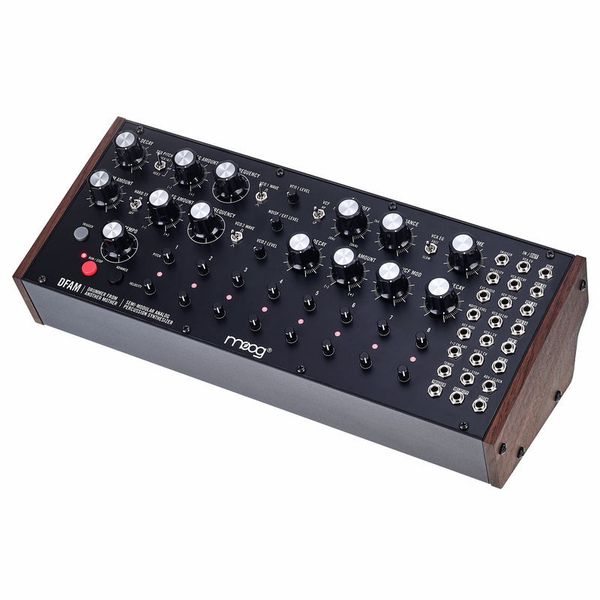
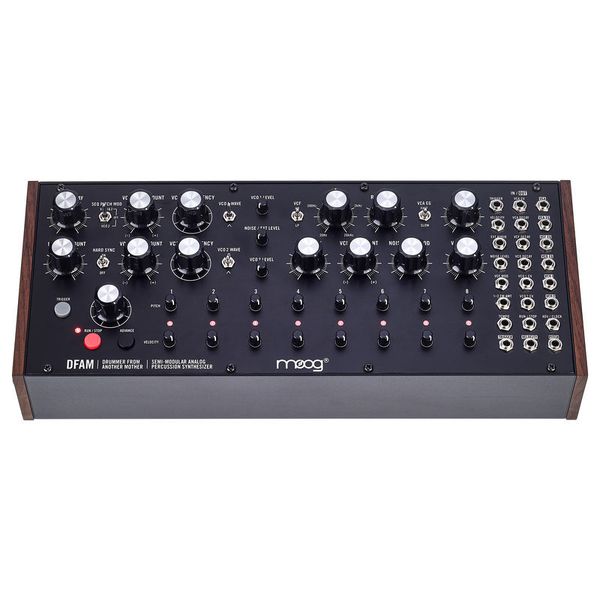
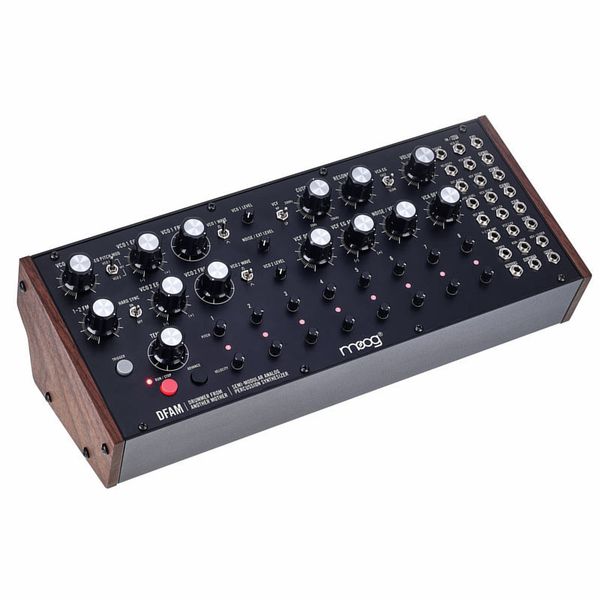


Semi-modulaire analoge percussie-synthesizer
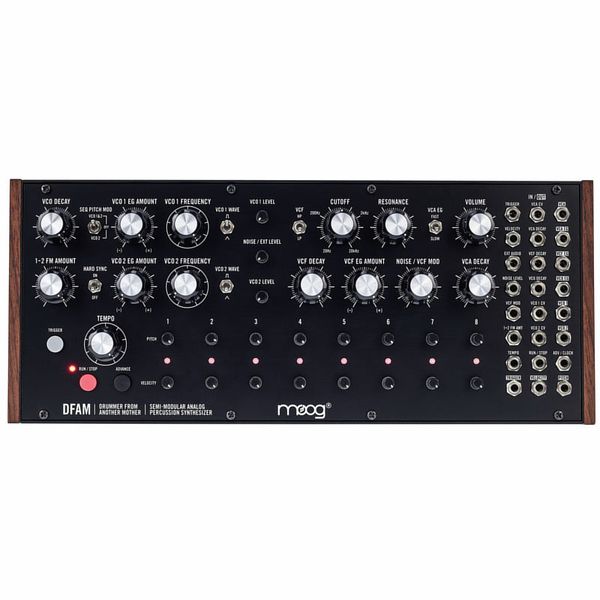
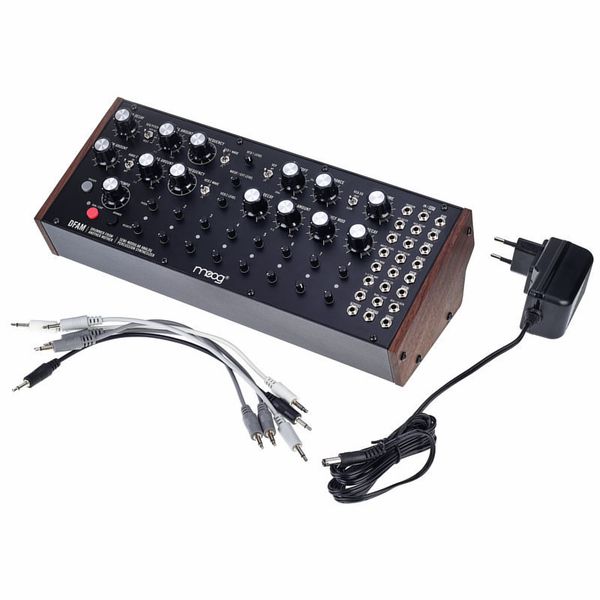
- Twee oscillatoren met blok- en driehoeksgolfvormen en white noise generator
- Omschakelbaar lowpass / highpass 4-pole transistor ladderfilter 20 - 20.000 Hz
- Analoge 8-step sequencer
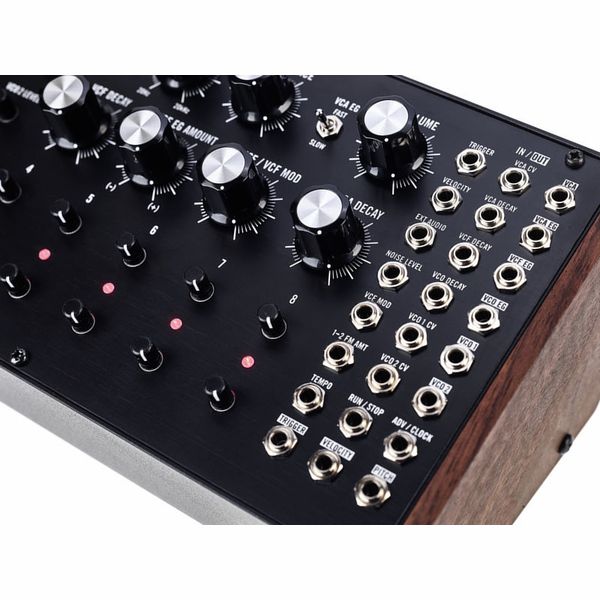
- Geïntegreerde patchbay 24x 3,5 mm mini Jack
- Patchbay-ingangen: Trigger, VCA CV, Velocity, VCA Decay, External audio, VCF Decay, Noise Level, VCO Decay, VCF Mod, VCO 1 CV, 1-2 FM Amount, VCO 2 CV, Tempo, Run/Stop, Advance/Clock
- Patchbay-uitgangen: VCA, VCA EG, VCF EG, VCO EG, VCO 1, VCO 2, Trigger, Velocity, Pitch
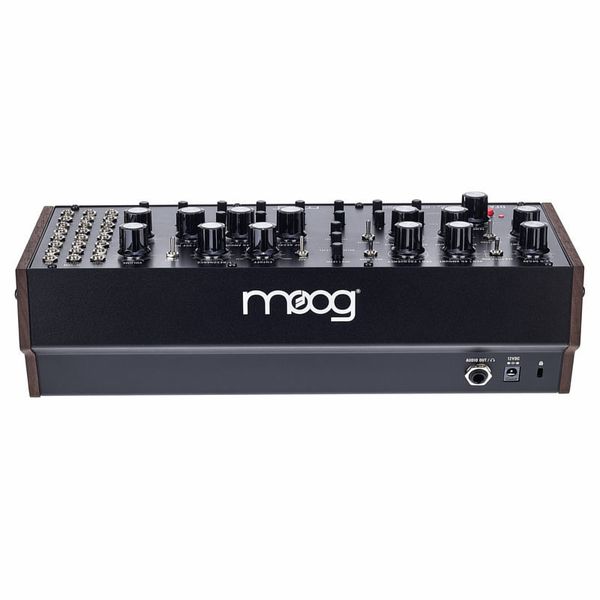
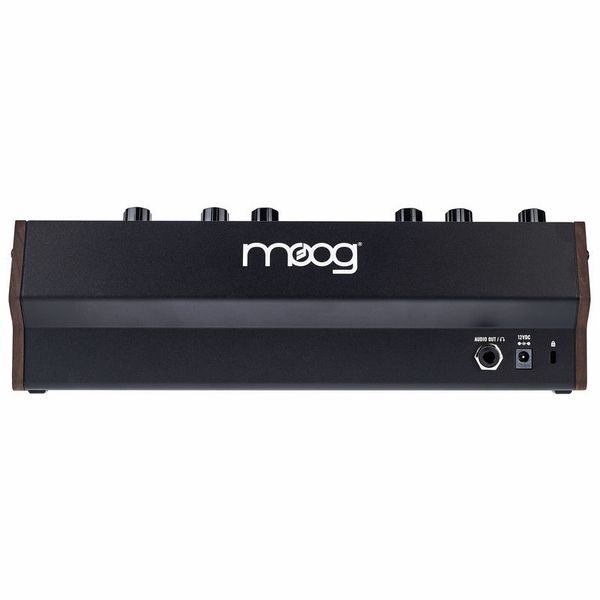
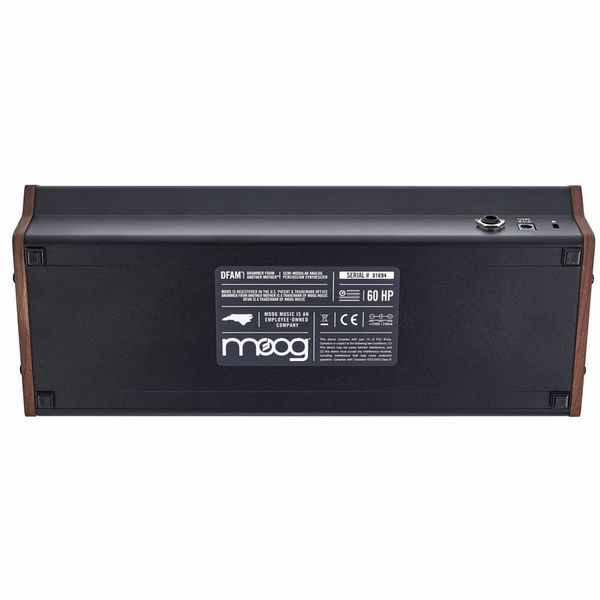
- Line output via 6,3 mm Jack
- Hoofdtelefoonuitgang via 6,3 mm Jack
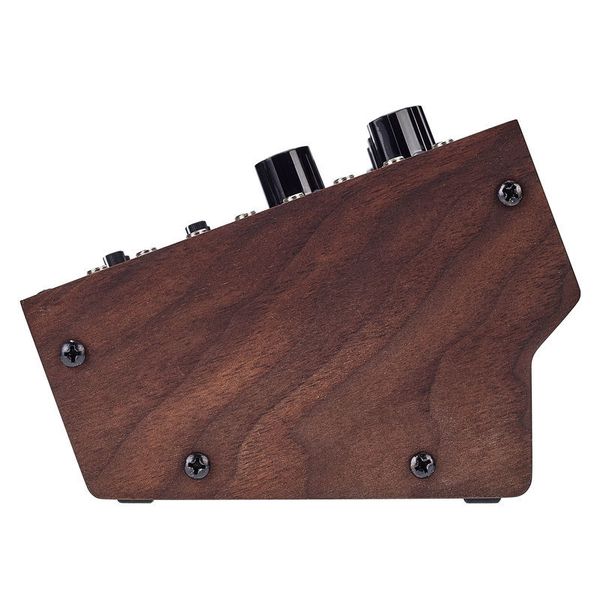
- Afmetingen (B x H x D): 319 x 107 x 133 mm
- Formaat: Eurorack 60 HP x 26 mm (B x D)
- Gewicht: ca. 1,59 kg
- Incl. externe netvoeding en een set Moog-patchkabels
- Bijpassende koffer: art. 505270 (niet bij de levering inbegrepen)
- Bijpassende cover: art. 484167 (niet bij de levering inbegrepen)
- Bijpassende tas: art. 490662 (niet bij de levering inbegrepen)
-
Leverbaar sinds Maart 2018
-
artikelnummer 430321
-
verkoopseenheid 1 stuk
-
Design Desktop
-
Polyphony 1
-
Sound Generation Analogue
-
MIDI interface No
-
Storage Medium None
-
USB-port No
-
Effects No
-
Arpeggiator No
-
Number of Analog Outputs 1
-
Digital Output No
-
Display No
-
Width 60 TE / HP
-
Optional Expansions None
-
Special Features Eurorack compatible
-

More than meets the eye
The Moog DFAM (Drummer From Another Mother) is anything but an ordinary synthesizer: It has an almost unique focus on creating percussive sounds. So it's a drum machine? Well, not quite. It's perfectly possible to use it to create melodies and pads, but the approach is refreshingly different. The DFAM has two analogue oscillators, a noise generator, Moog's 24dB/octave ladder filter, and three envelopes for shaping oscillator pitch, filter cutoff, and amplitude. This might make the sound synthesis options sound limited compared to other synths, but that's simply not the case. Instead of giving producers ready-made drum hits, it creates them whole-cloth using analogue synthesis. Much of this is driven by the built-in eight-step sequencer, whose steps can influence pitch and dynamics, delivering punchy kicks, metallic zaps, and even simple melodies. The Moog DFAM can do far more than meets the eye – or ears.
)
Patch and play
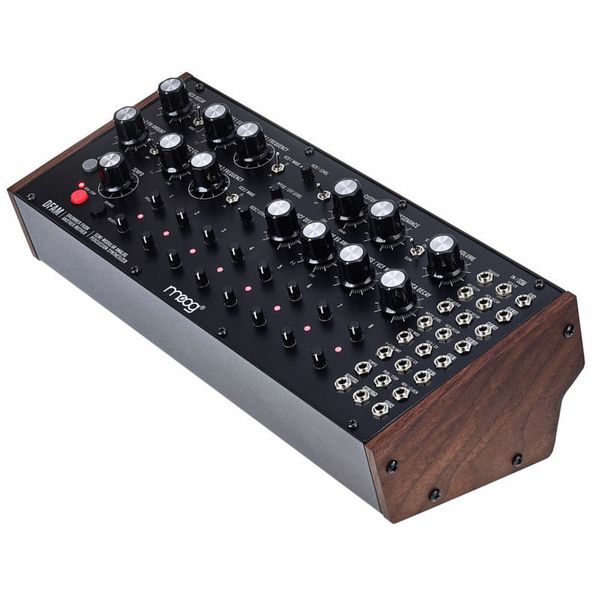
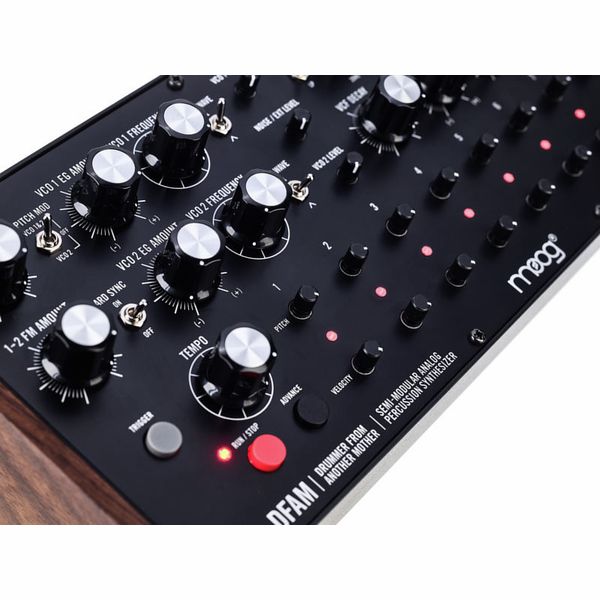
As with Moog's Mother-32, the main playing surface of the DFAM has a patchbay, this time with 24 patch points for creating complex modulation and signal-routing combinations. The sequencer is built around two rows of eight controls for pitch and velocity. These two rows of dials are the basis for every sequence made with the DFAM, with one row determining the pitch of each step and the other controlling its velocity and therefore how strongly the sequence interacts with the synthesis engine. It's often the multiple patch connections that produce the complex rhythms and sonic movement that make the DFAM so special. By patching the pitch into the noise level, for instance, musicians can create an entire range of new hi-hat hits. And the sounds get really unusual when the oscillators are patched for FM, or when the filter is pushed to extremes. The Moog DFAM is certainly not a straightforward synth, but all the more interesting for it.
Everything is expanded
Moog's Drummer From Another Mother is an instrument that doesn't seem like a necessity – until suddenly, it is. The range of sounds it's capable of and the amount of exploration it encourages can be almost overwhelming, while the semi-modular patchbay provides considerable scope for expanding its synthesis architecture even without additional equipment. Unlike modern grooveboxes and drum machines, though, the DFAM offers no way to save sounds or sequences. Every change and adjustment is made entirely using the dials and patch cables, so users would be well-advised to record their most interesting creations immediately – exact replication is often impossible. Anyone looking for a traditional drum machine is likely to be disappointed, but artists prepared to experiment in search of unusual rhythms and entirely new sounds will find plenty to explore.
)
About Moog
The US manufacturer of synthesizers, based in Asheville, North Carolina, is one of the pioneers in this field and has legendary status. Robert Moog had been involved with electronic sound generation since the 1950s and his first experience was with the manufacture of theremins. The breakthrough came in 1968 with the Grammy-winning album "Switched-On Bach" by musician Wendy Carlos (then known as Walter Carlos), recorded in multitrack with a mono synthesizer. The Minimoog, released in 1971, became the most popular synthesizer of the 1970s and is still considered the benchmark for the quality of synthesised sounds. It and the following devices, like the Memorymoog, Polymoog, and Prodigy, shaped the sound of countless albums, from Stevie Wonder to The Police and from Saga to Kraftwerk.
)
A match made in heaven
The Moog DFAM is a dream come true for producers who want unique, individual drum and percussion sounds. But it's also capable of entire sonic landscapes: With long decay times, slowed-down sequences, and clever modulations, this percussion-oriented synth can transform into a source of drones, atmospheric pads, and constantly evolving sound structures. Its entirely hands-on architecture also makes it a distinctive live instrument, with sounds and sequences manipulated directly rather than recalled from memory. Like the Mother-32, the DFAM is Eurorack compatible, so it also invites connections with other Eurorack devices or the Moog Mother itself – expanding its modulation and sequencing possibilities considerably and making the two semi-modular Moogs natural partners.
Dit is wat klanten die dit product bekeken hebben kochten

Accessoires & verwante producten
Vergelijk opties
-
Moog Expanders in een oogopslag
-
Expanders in de prijscategorie van 500 € - 1000 € weergeven
-
naar productgroep Expanders
-
naar productgroep Drum Modules
-
naar productgroep synthesizer
-
naar productgroep Toetseninstrumenten
-
toon fabrikant details voor Moog
-
Moog Toetseninstrumenten in een oogopslag