


Behringer Model D B-Stock

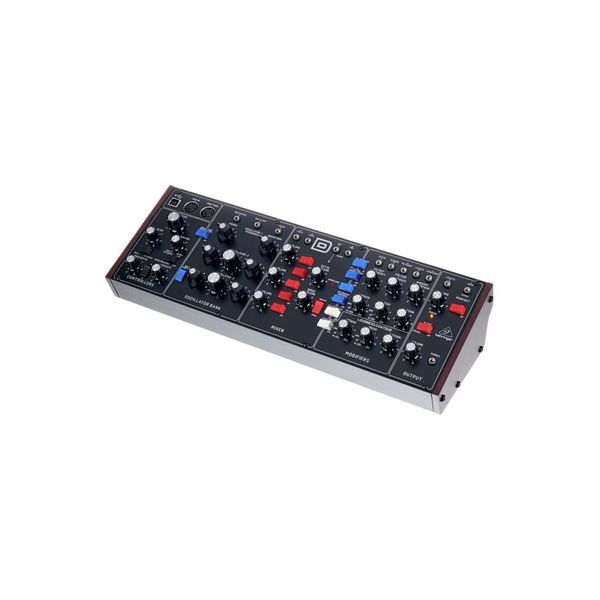
Analoge Desktop Synthesizer met Klassiek Ontwerp
- Analoog signaalpad (VCO-Mixer-VCF-VCA)
- 3 VCO's met 5 golfvormen
- Ladderfilter van 24 dB met resonantie
- Highpass- / lowpass-modi
- Analoge LFO met blok-/driehoeksgolfvormen
- Monofone geluidsgeneratie met polychain-mogelijkheid voor maximaal 16 stemmen
- Ruisgenerator
- Overdrive-circuit
- Semi-modulair met 13 patch points
- 49 Bedieningselementen voor directe toegang
- Kan worden gebruikt als een volledige Eurorack-synthesizerstem (breedte: 70 HP)
- 3,5 mm Audio-ingang voor geluidsverwerking van externe bronnen
- 2 Line outputs (6,3 mm) met verschillende niveaus
- 3,5 mm Hoofdtelefoonuitgang
- MIDI In/Thru en USB-MIDI
- Afmetingen: 90 x 374 x 136 mm
- Gewicht: 1,7 kg
- Incl. netvoeding (12 VDC, 1.000 mA)
- Bijpassende koffer: art. 480288 en art. 483012 (beide niet bij de levering inbegrepen)
-
Leverbaar sinds September 2018
-
artikelnummer 449948
-
verkoopseenheid 1 stuk
Revival of the greatest analogue classic
Behringer's Model D is a modernised, compact, and affordable reference to a pioneering synth classic that, in the 1970s, shaped the general structure of synthesizers and established sound categories such as synth bass and lead sound. This synthesizer delivers all the elements of the original, such as the three VCOs with five waveforms each, the famous 24dB low-pass filter after the cascade circuit, and a mixer with switches, a noise generator, and ADS envelopes. What is more, the Model D makes a convincing case thanks to even more useful functions: The filter for example can also be used as a high pass, and there is a separate LFO. Additionally, there are 13 patch points for a connection to modular devices and up to 16 units can be linked via MIDI (in a polychain) ensuring that you can play the synthesizer polyphonically - something that users could only dream of during the epoch of the illustrious original.
)
Monophonic analogue synthesizer with semi-modular connectivity
The Model D can either be set up with its lectern-style case as a desktop synthesizer, or you can remove it from the case and install it in a Eurorack modular system. As a monophonic synthesizer, it develops a very powerful basic sound with its three VCOs. For beat amplitudes, the VCOs can easily be put out of tune with each other but can also be used to create arbitrary, even extreme intervals with up to five adjustable octave ranges. With its distinctive resonance, the 24dB filter plays a big part in the sound and can even be used as a sound generator when it is self-oscillating, for example for analogue percussion or SFX. With its features, the Model D, like its role model, is predestined for extremely powerful bass and punchy lead sounds. However, its potential for controlling external modulation sources and step sequencers can be significantly expanded via the patch points.
)
Compact module for every setup
As a monophonic synthesizer, the Model D also functions as part of a setup, whether in the studio or on stage. With its compact design, however, you can place it wherever you want. In the studio, the synthesizer can be controlled from a DAW via USB/MIDI or using a normal master keyboard via the conventional DIN MIDI socket. The analogue CV/gate connections can be used without limitation in both the desktop case and rack installation. A synthesizer like the Model D is particularly suitable for musicians who want to bend and shape the sound while playing. Both when playing a keyboard with one hand and when controlling it with a sequencer, the sound can truly be brought to life by turning the controls and seeing where your intuition takes you.
)
About Behringer
The company, which was founded in Germany by Uli Behringer and now manufactures its products in China, has been known for affordable and great-value equipment since its very first product, the Studio Exciter F. An array of mixing consoles (such as the Eurodesk MX8000), signal processors, and later sound amplification and monitoring equipment, has made it possible for countless musicians to fit out their home studios, practice rooms, and mobile PAs within budget limits that were previously unthinkable. The acquisition of other companies, including Midas, Klark Teknik, and TC Electronic, meant that new product groups were added - and also resulted in the technical expertise of these companies being incorporated into product development.
A specialist in powerful sounds
The original on which the Model D is based was from its very beginnings the first choice for thundering synth basses, creamy leads, snappy sequence figures, and synth FX. It is equally popular in Rock, Funk, classic Electronica, modern R&B, G-Funk, and Pop. It is still held in the same high esteem as before, and cuts an equally fine figure in retro tracks and modern productions. The combination between the VCOs and the style-defining filter creates a very powerful bass output. An external sequencer or arpeggiator comes in handy by triggering the snappy envelopes that in turn control the filters. The sounds of this synthesizer aren’t tied to one era or style: With their unmistakable presence, they give a song all the positive aspects that are attributed to analogue synthesizers.
)
In the spotlight: Polychain
Smaller synthesizers can only produce a limited number of voices, so linking several devices is a way to increase the level of polyphony or, in this case, to achieve polyphony in the first place. This requires the implementation of a so-called polychain function, in which the devices are connected in series via MIDI. When MIDI notes are received, the notes that exceed the number of voices on the first device are passed on to the next. This process can be repeated until the capacity of the entire chain of devices is fully assigned, so the actually monophonic Model D can also produce polyphonic soundscapes. Of course, the same sound must be set for all devices. However, it is also possible to experiment with different sounds in the polychain.
