


API Audio 5500 Dual Equalizer

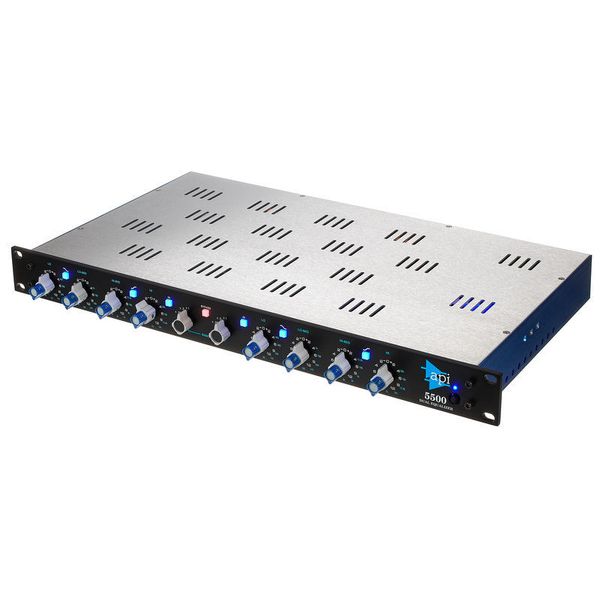

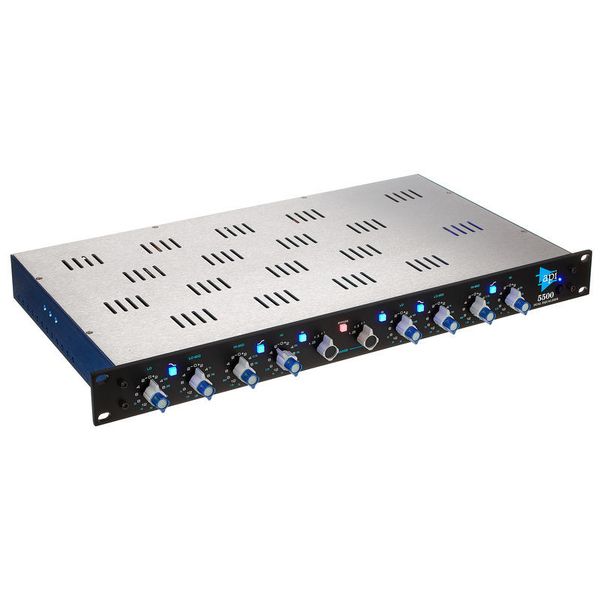


Equalizer
- 550B klassieke stijl
- Schakelbare niveau bereik voor fijnere resolutie van complexe
- Geluidsbronnen of mastering
- Eindtrap gerealiseerd met transformator (30 dBm)
- Hoge en lage Peak / Plank Filters
- Gebalanceerde ingangen en uitgangen (XLR)
- Extra ongebalanceerde jack ingang per kanaal
- Interne voeding
- Met Hardwire bypass
-
Leverbaar sinds April 2010
-
artikelnummer 241690
-
verkoopseenheid 1 stuk
-
Channels 2
-
Frequency Bands 4
-
Tube(s) No
-
Height units 1 U
-
Connectors XLR
Legendary EQ, brought up to date
The API 550a EQ did more than introduce the original form of the 500 series format when it arrived in the late 1960s: It also became one of the few EQ classics that remain relevant today. With features that were highly innovative for their time and the sought-after sound of the day, the API EQ established itself as a serious rival to the models from Neve and Pultec. The 5500 Dual EQ is the current incarnation of the great American classic, the 550b. To meet the demands of modern production, it combines finer gain adjustment, balanced connectivity, and a true hardwired bypass in a compact two-channel 1U unit.


Four bands, seven points each
The API 5500 is a dual equaliser with four semi-parametric bands, each with seven switchable frequency points. The high and low bands can be switched between peak and shelving curves. Boost and cut are set in five steps (±2, 4, 6, 9, and 12dB), and the Range switches scale these by a factor of 0.5 or 0.25, channel by channel, for much finer adjustment. The 5500 works on the Proportional Q principle, with the filter bandwidth narrowed as boost or cut increases. The signal path is fully discrete, with hand-built API 2520 operational amplifiers and a transformer-coupled output, and a true hardwired bypass connects the input directly to the output. Rear-panel connections include balanced XLR inputs and outputs, plus a pair of balanced TRS inputs, while an integrated power supply eliminates the need for an external unit.

Precision without complexity
With its excellent sound and intuitive controls, the API 5500 makes precise tonal shaping straightforward. Its carefully chosen frequency points, Proportional Q design, and Range switching allow musical adjustments without unnecessary complexity. With no variable Q to set and reciprocal boost and cut curves, tonal adjustments remain predictable. The distinctive shape of the rotary switches even allows adjustments by feel alone. This makes the 5500 approachable for engineers with limited production experience, while offering professionals an efficient, highly capable EQ with a broad range of applications.

About API Audio
API, or Automated Processes Inc., is one of the most iconic console manufacturers to have successfully adapted to the modern audio world. Established in 1969 by Saul Walker and Lou Lindauer in New York City, API's early consoles featured the 500-series modular format, a standard that remains popular today. During the "Golden Era of Recording," API became known for its innovative designs, supplying consoles and peripherals to prominent studios, artists, and broadcasters, particularly in the United States. After some challenges in the 1990s, the company restructured and has operated successfully from Maryland since 1999, delivering high-quality professional audio technology.

Not only for rockers
Although the API EQ owes much of its fame to legendary Rock productions, it is by no means limited to Rock. With its well-judged, overlapping frequency points, the 5500's sonic concept works with nearly any kind of modern programme material. Originally conceived as a channel EQ, it also makes subtle bus processing considerably easier through its Range switching and can even be used in mastering. A further characteristic of the classic API sound is a subtle compression-like effect, perceptible even at neutral EQ settings, which can add presence and help a signal stand out in the mix. Whether as part of a high-quality recording chain or as a mixdown or bus EQ, the API 5500 delivers a distinctive, refined sound suited to almost any instrument or musical genre.


