Naar de inhoud van de pagina

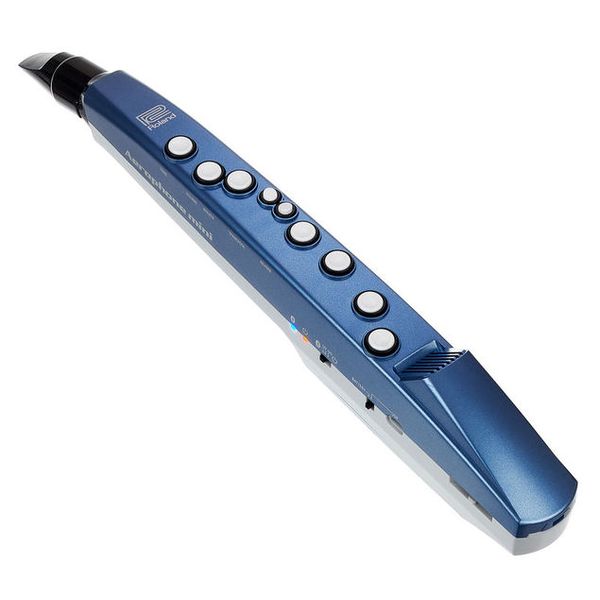
Compact digitaal blaasinstrument

  • Maakt snel leren mogelijk dankzij eenvoudige vingerzetting op basis van een traditionele recorder
  • 6 geïntegreerde sounds (saxofoon, fluit, klarinet, viool en meer)
  • Reverb-effect
  • Ingebouwde luidspreker
  • Werking op batterijen (4 x AA Mignon)
  • 50 extra geluiden en 11 tutorial songs via gratis app (beschikbaar voor iOS en Android)
  • Bluetooth 4.2 voor audio- en MIDI-transmissie
  • Stereo koptelefoonuitgang (3,5 mm aansluiting)
  • Micro-USB-poort
  • Afmetingen (B x H x D): 451 x 43 x 81 mm
  • Gewicht: 500 g (inclusief batterijen)
  • Incl. mondstuk-dop, riem, USB-kabel en gebruiksaanwijzing
  • Leverbaar sinds September 2019
  • artikelnummer 473836
  • verkoopseenheid 1 stuk
B-Stock vanaf € 243 beschikbaar
€ 281
Alle prijzen incl. btw
Direct leverbaar
1

Digital wind instruments: Versatile and easy to play

With the Aerophone mini AE-01, Roland offers a compact digital wind instrument that is designed to provide an accessible introduction to playing and combines simple fingering with an interactive smartphone app. Its fingering system is based on the recorder, a familiar instrument often used for introducing children to music, while the digital pressure sensor responds to the player's breath rather than relying on a traditional acoustic mechanism. Six built-in sounds can be played through the built-in speaker or headphone output, with the "Aerophone mini Plus" app for iOS and Android providing access to additional sounds via Bluetooth. The app also includes a selection of exercises designed to support the learning process and make it easier to become familiar with the instrument.

Excellent sounds with digital technology

The responsive touch sensor works together with digital sound processing to provide a clear and consistent playing experience, with a PCM synthesizer at the core of the Aerophone generating its sounds through digital sampling technology. Compared with traditional wind instruments, the digital design is less dependent on specialised breathing techniques, making it easier to approach for players who are still developing their technique. A built-in reverb effect adds the ambience of a concert hall, while the built-in speaker faces the player so that the notes remain easy to hear while playing. The Aerophone can also function as a MIDI controller for use with DAWs, sending MIDI data either via USB or wirelessly through Bluetooth, and the package includes a USB cable, mouthpiece cap, strap, and user manual.

Perfect for beginners

The six-key fingering system used on the Aerophone mini AE-01 makes it particularly approachable for beginners, with the left hand covering B, A, and G and the right hand playing F, E, and D. Two additional keys operated with the left little finger allow the pitch to be raised or lowered by a semitone, while a control on the rear of the instrument extends the range by shifting the pitch up or down by an octave. This gives the Aerophone a total range of three octaves, while its weight of just 500g keeps it comfortable and easy to handle. The mouthpiece can also be replaced with compatible Roland models such as the OP-AE01MP or OP-AE05MPH, available separately, and the accompanying app offers a variety of exercises with adjustable tempos to help beginners gradually develop their playing skills.

About Roland

Roland was founded in 1972 in Osaka, Japan, and has been designing and building electronic musical instruments ever since. During its successful history, Roland has launched many ground-breaking instruments, from legendary drum machines such as the TR-808 and the TR-909 to synthesizer classics like Jupiter-8, SH-101 and the iconic TB-303. Besides synthesizers, Roland's workstations and electric pianos are also very popular. Equally well-known is Roland’s subsidiary Boss, under whose brand name it designs and sells principally guitar pedals and effects units. Under the Roland Professional A/V label, the company additionally develops and distributes professional equipment for virtually every branch of audio and video production – from home studios through to commercial applications.

Learn to play via smartphone app

To use the Aerophone mini Plus app, the corresponding mode first needs to be selected on the instrument, after which a wide range of functions becomes available. In addition to more than 50 sounds, the app includes 11 pieces of music and numerous exercises designed to support the learning process, with the correct fingering displayed visually for each note. Exercise tempos can be adjusted to suit the player, making it possible to begin slowly and gradually speed up, while individual fingering patterns can be customised and stored in up to ten presets for later use. The pressure sensor sensitivity can also be adjusted so that the instrument responds to a lighter breath, and music from a personal library can be streamed via the app with the volume of the vocals lowered for karaoke-style accompaniment. The audio is transmitted wirelessly to the Aerophone AE-01 via Bluetooth and can be monitored either through headphones or the built-in speaker.

24 Klantenbeoordelingen

4.3 / 5

18 Recensies

E
I still use it.
EdmundC 09.08.2023
I bought this learned to play this by myself and personally still enjoy it. the flute and clarinet are the best sounds without the app. I am disappointed that Roland didn't came with a newer version of this instrument with more and realistic sounds as it is very user friendly to learn and play. I would surely buy it. Instead they came with newer version of the much more expensive models. I only want the recorder fingering with better sounds.

Pros: Well built and very easy to learn and master. Batteries last very long.
Cons: Only the flute sound is realistic. The app with more sounds are limited and there is latency. Occasionally the spring to hold the batteries just jumps out but was easily to to click back in.

I still like it.
0
0
Evaluatie melden

Evaluatie melden

google translate de
Helaas is er een fout opgetreden, probeert u het a.u.b. later nogmaals.
K
Was man wissen sollte...
Kababär 05.10.2020
... wenn man sich damit befasst, das Gerät zum stillen üben für Blockflöte zuzulegen, um Tiere oder Nachbarn zu schonen.

Ja, die Griffe sind an die Blockflöte angelehnt, im Prinzip sogar optimiert, aber da haben wir auch schon das Problem: Zu einer vorhandenen Sopran- und Tenorflöte müssen bei 4 Noten Kompromisse sprich Alternativgriffe angewendet werden.

Während sowohl die deutsche als auch die barocke Griffweise des F anstandslos erkannt werden, fehlen beim C und D mangels Doppellöchern oder Halblochgriffen die gewohnten Griffe für C# und D#. Alternativ muss hier die #-Taste mit dem kleinen Finger der linken Hand zu Hilfe genommen werden, um das gegriffene C und D einen Halbton zu erhöhen.

Das gewohnt gegriffene hohe d#' klingt standardmäßig wie das hohe c#', kann aber mit Hilfe der App auf das d#' umprogrammiert werden. Wie das funktioniert, ist nirgends dokumentiert, erst durch Ausprobieren konnte herausgefunden werden, dass die Speicherung im Gerät nur dann erfolgt, wenn bei bestehender BT-Verbindung die gegriffenen Löcher nicht in der App angetippt werden, sondern zwingend am Gerät gegriffen werden, die App erkennt dann den Griff und die Speicherung ist erfolgreich. Also bitte nicht verwirren lassen, wenn man die Eingaben in der App machen möchte und dies auch visuell in der App angezeigt wird.

Problematischer sind aber die Griffe für das hohe c#' und d'. Üblicherweise öffnet man hierfür nur das Daumenloch, ansonsten entspricht es den Griffen A bzw. H. Da aber die Daumenlöcher für diese Gerät nicht programmiert werden können, ist eine authentische Umprogrammierung auf die gewohnten Flötengriffe nicht möglich.
Stattdessen sind diese Töne aber werksseitig so hinterlegt, dass man vom hohen c' ausgehend mit dem Ringfinger der linken Hand auf den nächsten Knopf das hohe c#' und mit dem kleinen Finger der linken Hand auf der #-Taste das hohe d' greifen kann.

Ansonsten folgt das Gerät standardmäßig folgendem Prinzip:
Deutsche oder barocke Griffweise der ersten Oktave für die Ganztöne, #- bzw. b-Taste für die Halbtonschritte und mit dem linken Daumen Oktave up oder down. Fertig.

Einige echte Flötengriffe funktionieren trotzdem, z.B. ab dem hohen e' greift man die Oktave up (anstelle dem halben Daumenloch) oder auch einige echte Halbtongriffe sind werksseitig, aber eben nicht alle (s.o.).

Ja, das Gerat ist wie auch innerhalb der traditionellen Flöten als eigenständiges Gerat zu sehen, das seine eigene Grifftabelle mitbringt. Zudem bietet es hervorragende Möglichkeiten zum stillen üben und auch ansonsten ist das Prinzip gut durchdacht, so dass ich hier trotz der obigen Einschränkungen 4 Sterne vergebe. Ohne die Einschränkungen wären 5 Sterne drin gewesen, aber eine Umstellung innerhalb der Geräte ist kein "echtes" Üben.

Noch ein Tip, wenn die BT-Kopplung unter Android versagt, Standortfreigabe aktivieren, dann sollte es gehen, ist ein Android-Problem und liegt nicht an diesem Gerät.

In der App kann man zusätzlich zum chromatischen Transponieren auch bis zu 2 Oktaven höher oder niedriger transponieren und dies dauerhaft im Gerät abspeichern. So kann man aus einer Sopranflöte locker eine Tenorflöte oder eine Bassflöte machen. Mit der chromatischen Transposition ist auch schnell eine F-Flöte eingerichtet...
35
0
Evaluatie melden

Evaluatie melden

google translate fr
Helaas is er een fout opgetreden, probeert u het a.u.b. later nogmaals.
AM
Très interessant
Antoine M 03.02.2020
Très bon instrument, qualité de fabrication simple mais satisfaisante.
facilité d'utilisation et un application très intuitive permet d'apprendre quelques morceau, de faire sortir le son de son téléphone et d'utiliser plusieurs dizaine d'instruments différents.
Très bon outils à utiliser partout. En effet on obtient pas un son de la qualité d'un vrai cuivre mais ce n'est pas mal et on ne peut pas jouer de cuivre dans un appartement et les prix ne sont pas les même. J'en suis donc très content.
7
0
Evaluatie melden

Evaluatie melden

google translate pl
Helaas is er een fout opgetreden, probeert u het a.u.b. later nogmaals.
K
Aeorophone mini
Kuba;) 31.03.2025
Jednym z największych atutów tego instrumentu jest jego wszechstronność. Roland oferuje szereg brzmień oraz efektów, które pozwalają na eksperymentowanie z różnymi stylami muzycznymi, od jazzu po pop. Dodatkowo, możliwość podłączenia do różnych urządzeń, takich jak komputery czy aplikacje mobilne, otwiera nowe możliwości twórcze, umożliwiając nagrywanie i edytowanie utworów w czasie Lekka konstrukcja i ergonomiczny kształt sprawiają, że saksofon jest łatwy w obsłudze, a jego bateria zapewnia długotrwałe granie bez konieczności podłączania do zasilania. Dla każdego, kto szuka instrumentu, który łączy nowoczesną technologię z klasycznym brzmieniem, cyfrowy saksofon Rolanda w tej ramie finansowej, jest zdecydowanie najlepszym wyborem.
0
0
Evaluatie melden

Evaluatie melden