

Naar de inhoud van de pagina

Actieve 3-Weg Studiomonitor

  • Linkse monitor
  • 7" Midrange speaker - vermogen 300 watt
  • 4" midrange speaker - vermogen 300 watt
  • 2" AMT tweeter - vermogen 300 watt
  • Frequentiebereik: 32 - 40.000 Hz
  • Maximum niveau: 120 dB
  • DSP-systeem met geïntegreerde lineariser-technologie
  • Analoge ingang: XLR gebalanceerd
  • Digitale ingang: AES IN
  • Digitale uitgang: AES Through
  • Resolutie: 24Bit / 96KHz
  • Ingangssignaalsterkte: ±12 dB
  • Shelf-filter low/high: ±4 dB
  • Desk-filter
  • Afmetingen (H x B x D): 280 x 358 x 338 mm
  • Gewicht: 15,4 kg
  • Leverbaar sinds Januari 2021
  • artikelnummer 508806
  • verkoopseenheid 1 stuk
  • Components 1x 7", 1x 4", 1x 2"
  • Power 3x 300 W
  • Frequency range 32 Hz – 40000 Hz
  • Magnetic Shielding Yes
  • Connectors XLR, AES
  • Measurements 280 x 358 x 338
€ 2.299
Alle prijzen incl. btw
Direct leverbaar
1

3-way monitoring made in Berlin

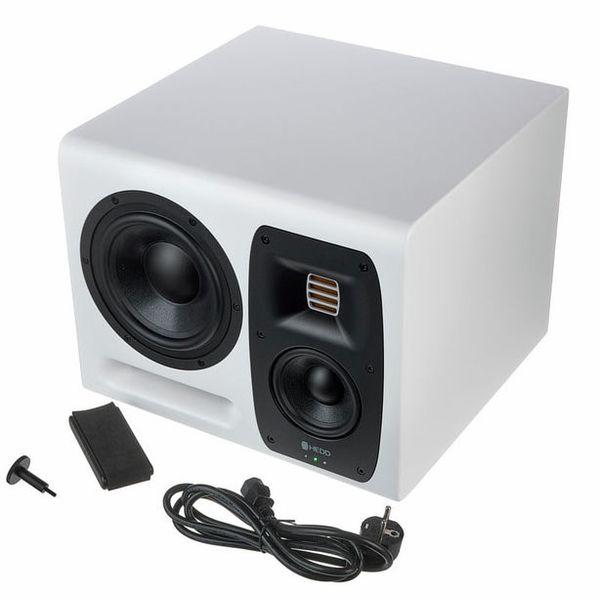
It would be wrong to refer to the HEDD Type 20 MK2 as the little brother of the Type 30: The Type 30 is simply a single centre unit, with the Type 20s designed as a pair of L/R monitors. Certainly, in terms of both power and range, the Type 20 and Type 30 are identical, with three 300W amps and a frequency response of 32Hz to 40kHz. As with the all the models in the series, there's also the integrated DSP, new in the MK2 versions. The key functional difference between the models is that each Type 20 has a single 7" low‑mid driver supporting the 4" midrange driver and 2" folded‑diaphragm tweeter, rather than a pair of low-mids. Its bass reflex system provides excellent, extended low‑frequency reproduction; for tighter, more defined bass, the port can be sealed with the removable plug it ships with. HEDD's proprietary Lineariser function uses delay compensation to optimise phase linearity, improving transient accuracy and stereo imaging. When using Type 20s together with a subwoofer from the HEDD Bass range, producers can linearise the setup's entire signal to synchronise the woofer's phase response as well.

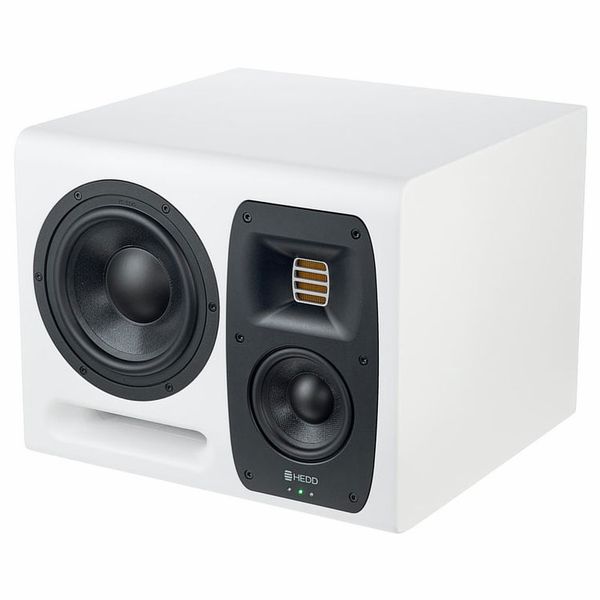
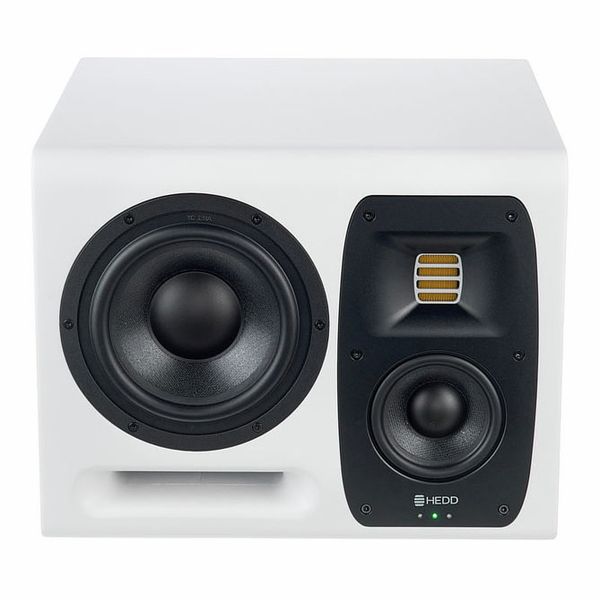
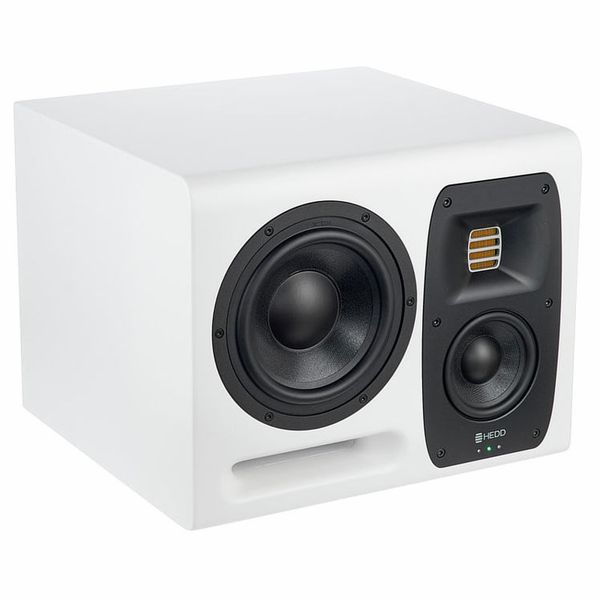
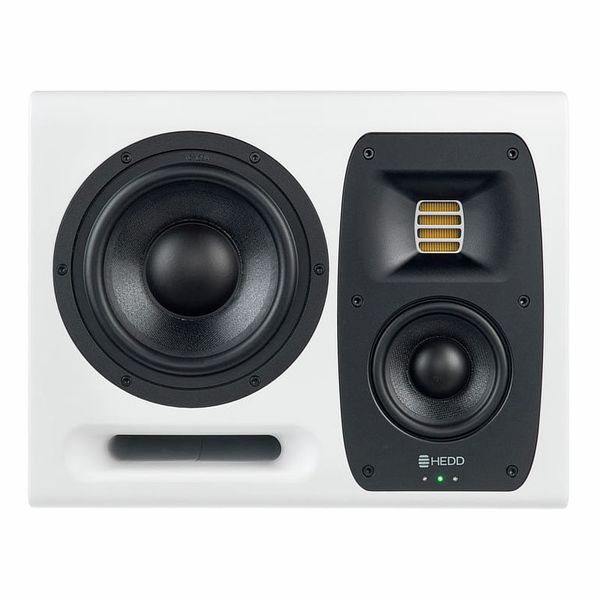
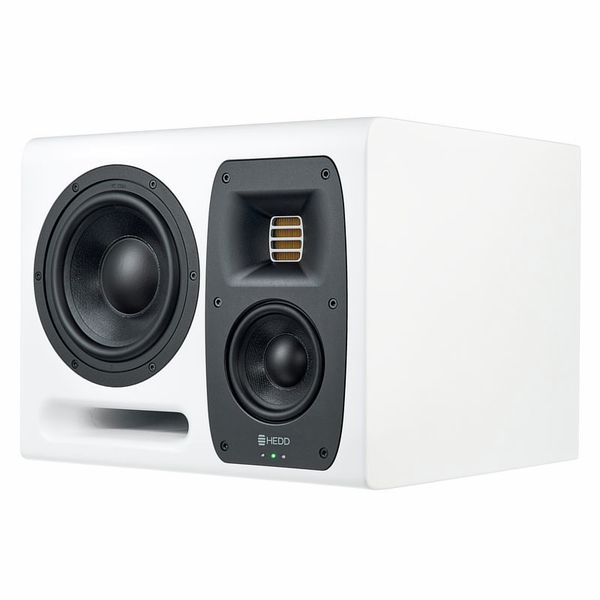
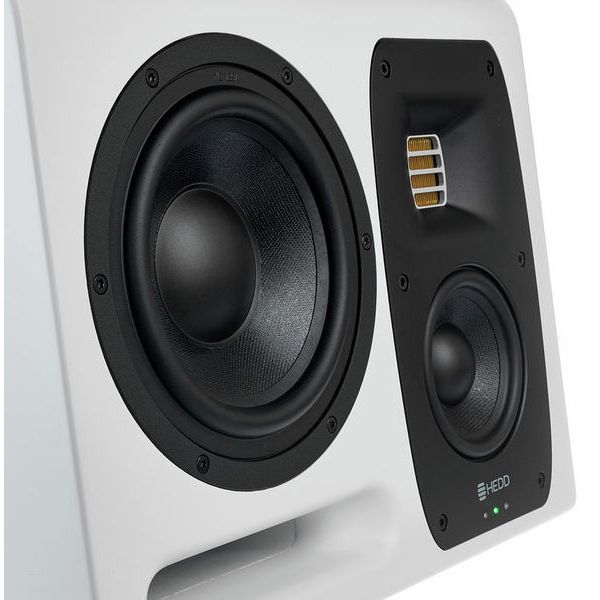
HEDD Type 20 MK2 Left White, studio midfield monitor

Grade-A DSP

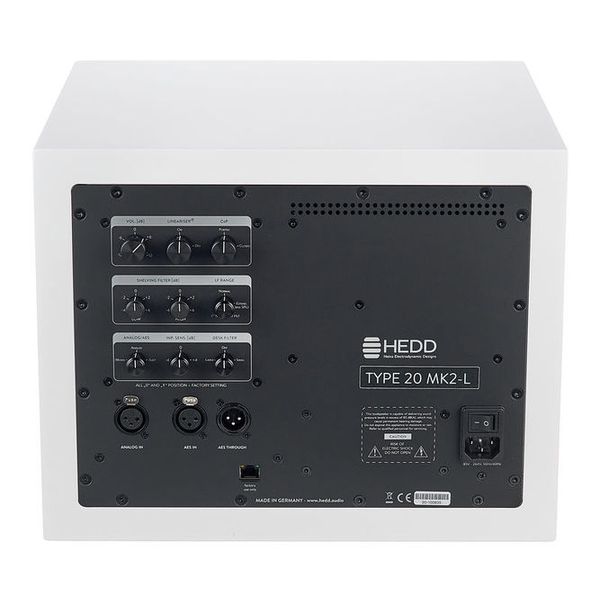
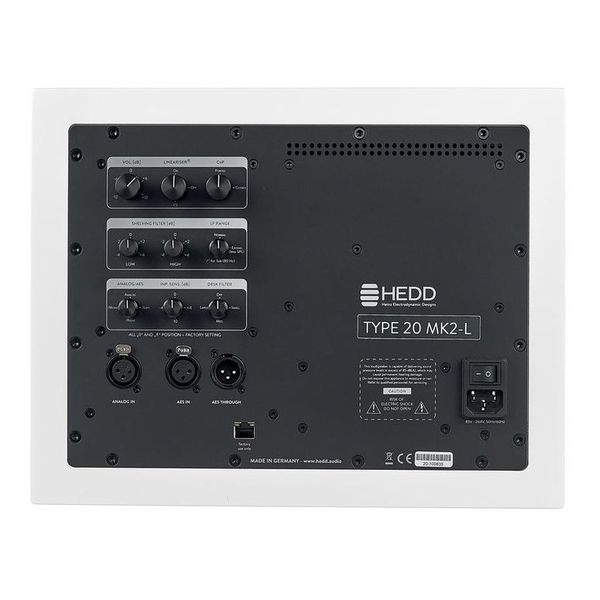
AD/DA converters with a 96kHz sampling rate and 32‑bit resolution give the DSP in the HEDD Type 20 the power to process audio with crystal‑clear precision. As with the other speakers in the series, there's a balanced XLR socket here for analogue signals, alongside a dedicated XLR connector for audio in AES format – which can be decoded as a stereo signal and passed through via a further XLR output, with a switch for choosing between the left and right channels. This is the left unit of the white-finish monitor pair: If used alongside the matching HEDD Type 20 MK2 Right White (article no. 508807), the pair delivers a maximum SPL of 120dB. The wide range of control options matches that of the Type 30 MK2, in that input level can be boosted or attenuated by up to 12dB, two shelving filters allow for adjustments to bass and treble, and there's even a desk filter on board.

Rear view of the HEDD Type 20 MK2 Left Whize, studio midfield monitor

A professional's eye for detail

Professional producers are sure to have space for a pair of HEDD Type 20s: This comparatively compact powerhouse is just under 39cm wide and, at a little over 15kg, lightweight enough to be accommodated on a wide range of speaker stands. Their combination of detail and dynamics allows studio owners to quickly put together pro-grade nearfield and midfield monitoring systems, capable as these speakers are of both effective elevated monitoring levels at medium distances and consistently precise sound reproduction. Those who already own a Type 20 or two will find the MK2 version's integrated DSP an immensely useful new feature, as it enables producers to adapt the speakers' output even more precisely to the acoustic conditions of the space they're working in.

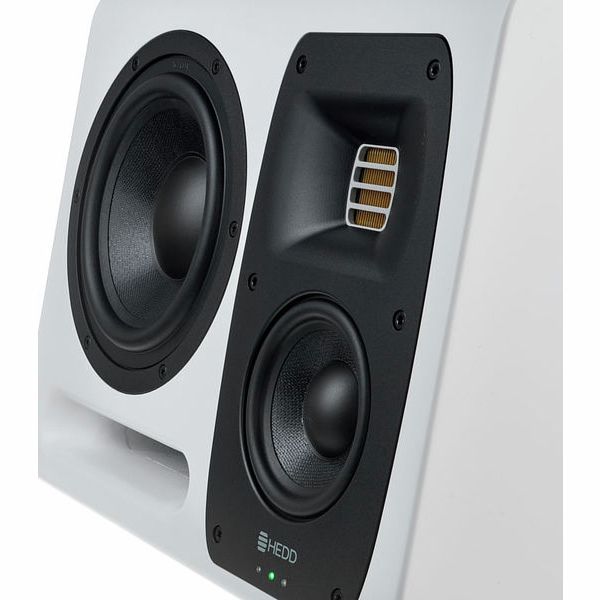
Manufacturer's logo on the HEDD Type 20 MK2 Left White, studio midfield monitor

About HEDD

The family-owned company HEDD Audio was founded in 2015 in Berlin, where it still manufactures its high-quality studio monitors, subwoofers, and hi-fi speakers, as well as headphones – or HEDDphones. The name HEDD stands for Heinz ElectroDynamic Design, after its founder Klaus Heinz (who also founded ADAM Audio); his son, who himself has a PhD in musicology, is now CEO. The company’s R&D work is based on their decades of experience, and its mission is to deliver outstandingly detailed sound and optimum signal quality. A whole host of renowned DJs and mastering engineers, including DJ Jazzy Jeff and Sascha "Busy" Bühren, swear by HEDD products for their day-to-day work.

Mark 2: For mixing, recording, even mastering

For recording spaces where the acoustics haven't been fully optimised with absorbers, resonators, and other treatment measures, the HEDD Type 20 MK2 is a great choice, helping producers achieve the best possible sound with its wide range of optimisation options. But even in a commercial control room with extensive acoustic treatment, the fine‑tuning capabilities of this loudspeaker can make a decisive difference. And in addition to its highly detailed reproduction, the sheer output of its three integrated amplifiers means it has enough headroom even for larger listening rooms. When two of these speakers are supplemented by a subwoofer, their phase response can be synchronised via the units' integrated DSP to deliver the most accurate and precise reproduction possible. All this means the HEDD Type 20 MK2 isn't just suitable for recording and mixing, but also offers producers the kind of sound quality needed for professional mastering setups.

3 Klantenbeoordelingen

4.3 / 5

features

geluid

afwerking

3 Recensies

google translate gb
Helaas is er een fout opgetreden, probeert u het a.u.b. later nogmaals.
NB
Insane!
Not Batman 08.11.2022
Like so many, I too was switching from ADAM to HEDD and here's my 2 cents.

As professional mixing & mastering engineer, accuracy, detail and sound stage is very important, what matters the most however is that the stuff you work on translates well. And for that I was looking into new speakers.

After hooking up the HEDDs for a first test, I almost fell of my chair. HOLY MOLY! Hello detail! The high resolution from top to bottom was insane. I never knew how much I was missing from my ADAMs.
I used it as closed port cabinet with low end extension mode on, linearizer on (duh).

For many days I just sat and listened to music until deep in the night (grateful to have a soundproof studio). I was hearing new things in music I had known for decades. I have heard quite many speakers in my time, but this one was special. Super detailed low and punchy and fast low end, clarity and forwardness in the mids and super detailed top end without fatiguing harshness.
The transient response and imaging was also something I had rarely heard before and probably never like this, even on much more expensive speakers!

Now here comes what to me kind of matters the most:
I of course also worked quite a lot on them, that's why I bought them in first place.
In the time I used the HEDDs I had exactly 0 revision requests for any work I had done, mixing/mastering/production/you name it...

Also the famous "car test" or in general listening to my work on other systems translated beautifully! That means a lot to me.

All in all my favorite speaker ever and I miss it dearly cause.... I sent it back to Thomann.. :P

I still want to try a few other speakers. But rest assured, if no other speaker can beat these HEDDs, which I assume to be very tough indeed,
I'll get the Type30 mk2 for the extra headroom instead and will never look back.

Don't get me wrong though. I honestly didn't feel like the Type20mk2 lacked anything. The low end, actually - the entire frequency spectrum was insane and the volume is much more than I'd actually need in a sensible working setting.
But for a big mastering room, I kind of want that extra woofer that the Type30mk2 would provide.
All in all I would say a sub is pretty much unnecessary with either of the two models.
I heard sub drops and sub bass better than ever and I used to have a sub here with a previous speaker setup, but never had such clear low end as with the HEDDs.

I could find only one thing to criticize; The hiss of the amps. Kind of surprised how hissy the speakers are (using the analog connection, my AES out is used for other things).
Definitely on the louder side of hisses.
I work in a big room, had them set up mid field/far field and still could hear the hiss.
But the moment anything is playing back, you don't really hear it anymore. Still kind of unexpectedly loud, though.

Instantly sold my ADAMs by the way. Wouldn't ever want to work on them again.
Music sounds just dull, 2 dimensional and lifeless on ADAM, even the more pricy models.
Of course that's just my opinion and you can have yours, but I can't be bothered with it anymore.

/my2cts
features
geluid
afwerking
4
0
Evaluatie melden

Evaluatie melden

google translate gb
Helaas is er een fout opgetreden, probeert u het a.u.b. later nogmaals.
A
Beautiful to look at and awesome sound.
ALI1991 14.04.2021
HEDD is great.
There is no denying that the KH310 does work well for the job, but it doesn't sound so approachable.
And then, I chose the TYPE20 MK2.
Fantastic!
The clear, transparent sound is very three-dimensional, and the large space makes you not want to stop. Long listening sessions are not overwhelming. While it "sounds good", it also expresses every frequency accurately, so you can easily find what you want in your work.
features
geluid
afwerking
2
0
Evaluatie melden

Evaluatie melden

google translate de
Helaas is er een fout opgetreden, probeert u het a.u.b. later nogmaals.
HH
Top Klang, aktiver SPDIF / AES Konverter vorausgesetzt
Heinzi Hempel 01.05.2021
Ich werde die Boxen behalten, obwohl ich trotz aller Versuche keine passive Übersetzung meines SPDIF Audiointerface Ausgangs auf den AES Eingang der Box herstellen konnte.

Nach langer Internet Recherche habe ich mich für die Boxen entschieden. Gerade der Lineariser und die exzellente Auflösung der Boxen - wenn auch in der neutralen Einstellung etwas bassbehaftet - übertreffen alles, was ich bisher gehört habe. Es ist, als würden andere Abhörboxen im Vergleich den Sound einmal durch 'nen Mixer jagen. Absolute Empfehlung, was die Klangeigenschaften betrifft und genau das ist der Grund, warum ich die Boxen dennoch behalte UND in weiss sind die Würfel einfach ein Traum!

Cons (Kritik auf hohem Niveau):
- das SPDIF Signal lässt sich nicht mit dem Neutrik NADIT BMC-M Konverter auf das AES Niveau heben/wandeln (75/110 Ohm Impedanzwandlung). Hierzu habe ich mir jetzt den aktiven Mutec mc-1.1 Konverter bestellen müssen. Details weiter unten
- die Boxen erwachen nicht zuverlässig aus dem Standby und es dauert wirklich länger, bis man Gewissheit hat, dass die Box nicht mehr aufwacht. Die Box bleibt ferner nach dem Ausschalten per Schalter weiterhin (ca. eine Minute) im Standby. Bis man sie also neu einschalten kann, ist man definitiv entnervt. Wer dieses Feature häufiger braucht, wird mglw. nicht glücklich.
- der Analogausgang meines Antelope Orion Studio Synergy Core (Klinke) erzeugt - warum auch immer nur an diesen Boxen - ein hochfrequentes Signal. Ich halte nichts davon, eine galvanische Entkoppelung vorzunehmen, mit entsprechenden Klangeinbußen, daher ist dieser Ausgang für mich nicht nutzbar. Analog aus einem Digitalaudiointerface in einen Class-D Verstärker zu gehen, der dann doppelt wandeln muss, ist in meiner Welt eh nicht schlüssig.

Diese Feature-Kritik basiert wirklich auf der sehr hohen Erwartung aufgrund eines entsprechend hohen Preises. Die SPDIF/AES Inkompatibilität war fast der Deal-Breaker, die anderen Einschränkungen sind für mich wenig relevant.

Klanglich kann ich die positiven Internet-Reviews der Boxen in Allem bestätigen. Sensationelle deutsche Ingenieurskunst aus Berlin. Möglicherweise gehöre ich zu einer Randgruppe, die im Consumerbereich (Antelope OSSC) Homerecording in Kombination mit Monitoren aus dem Profi-Segment betreibt und bin daher mit meiner Kritik auf weiter Flur allein (kann ich mir nicht vorstellen, denn gerade die Abhöre ist doch das absolut Wichtigste beim Mixing/Mastering). Evtl. sollte HEDD dieses Marktsegment nicht ignorieren und mit der neuen Version eine Impedanz und Pegelwandlung direkt mit integrieren.


-------------------------------------------------------------

Details zu SPDIF/AES:
- Ich habe vor dem Kauf bei HEDD nachgefragt ob die SPDIF/AES Verbindung kompatibel ist, hatte aber gerade zu dieser Frage keine Rückmeldung.
- Nachdem das mit den Boxen gelieferte SPDIF2AES Kabel nicht funktioniert hat, habe ich erneut bei HEDD nachgefragt. Aussage HEDD: Es brauche den Neutrik Konverter NADIT BMC-M.
- Konverter bestellt angeschlossen, und siehe da : Die erste Box erklang!!!
- AES Through Kabel (110 Ohm) zum Durchreichen des Signals an die erste Box eingesteckt - erste Box stumm
- Kurzes AES Through Kabel (110 Ohm) eingesteckt - erste Box lief weiterhin, Kabel mit der 2. Box verbunden: Beide stumm
- Am Ende habe ich Wochen damit verbracht, herauszubekommen, dass es nicht (zuverlässig) funktioniert. Manchmal - selten haben beide Boxen geklungen
- In der Zwischenzeit bei HEDD nachgefragt. Aktuelle Aussage: "wir haben herausgefunden, dass das SPDIF Signal zu schwach ist, um weiter transportiert zu werden."
- es liegt also nicht an dem Digitalformat, auch nicht daran, dass der Neutrik Konverter die Impedanz nicht zuverlässig wandelt, sondern daran, dass die erste Box das konvertierte und schwache Signal versucht an die 2. Box weiterzuleiten. Dadurch, dass hier allein schon die Kabellänge einen Unterschied macht, scheint die Pegelwandlung dass einzige Problem zu sein. Jetzt betreibe ich demnächst ein externes Gerät für diese Pegelwandlung (die sicherlich einige wenige Euro kostet, wenn HEDD diese in der Elektronik der Box direkt eingeplant hätte) - ärgerlich
features
geluid
afwerking
2
1
Evaluatie melden

Evaluatie melden