


Arturia MiniFreak B-Stock

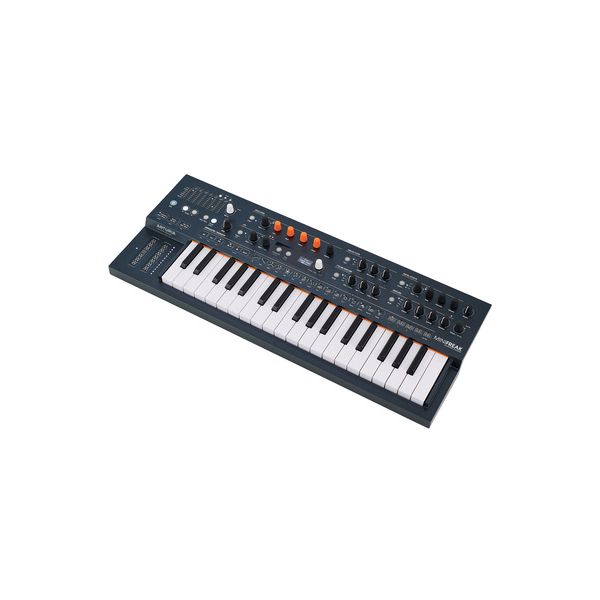
Algoritmische synthesizer
- 37 Aanslaggevoelige Slim-toetsen met Aftertouch
- 6-Stemmige polyfonie
- Twee digitale Sound-Engines per voice met 22 selecteerbare oscillatormodi: Superwave, Wavetable, Karplus Strong, Noise en nog veel meer
- Uitgebreide Modulation mogelijkheden incl. FM, Ring Modulation en wederzijdse beïnvloeding van de Sound Engine
- Per Voice: ADSR-envelope, multi-segment envelope/ LFO, twee LFO's en analoge multimode filter (Low-Pass, Band-Pass, High-Pass)
- Modulatiematrix met 7 bronnen en 13 bestemmingen
- 3 Effect slots (als insert of Send effect) met 10 effect types
- Performance Arpeggiator met Ratcheting en Random functies
- Step sequencer met 64 steps
- Intuïtieve bediening via OLED-display en 40 knoppen, encoders en toetsen
- Geheugen voor 256 factory en 256 user presets
- Stereo line-uitgang: 2x 6,3 mm jack
- Line-ingang: 6,3 mm jack
- Stereo hoofdtelefoonuitgang: 6,3 mm jack
- Aansluiting Sustain pedaal: 6,3 mm jack
- Clock in/out en Reset uitgang: 3,5 mm jack
- MIDI in/uit/thru
- USB-B-poort
- Afmetingen (BxDxH): 578 x 231 x 55 mm
- Gewicht: 2,94 kg
- Incl. externe netadapter (12V DC, 1A), USB-kabel en MiniFreak V-software (download)
-
Leverbaar sinds November 2022
-
artikelnummer 555338
-
verkoopseenheid 1 stuk
-
Number Of Keys 37
-
Touch-Sensitive Yes
-
Aftertouch Yes
-
Split Zones No
-
Modulation Wheel Yes
-
Number of simultaneous Voices 6
-
Sound Engine Digital
-
MIDI interface 1x In, 1x Out, 1x Thru
-
Storage Medium Internal
-
USB-port Yes
-
Effects Yes
-
Arpeggiator Yes
-
Number of Analog Outputs 2
-
Digital Output No
-
Display Yes
-
Pedal Connections 1x Sustain
-
Dimensions 578 x 231 x 55mm
-
Weight 2,9 kg
-
A hybrid synthesizer built for discovery
The Arturia MiniFreak is a six-voice polyphonic hybrid synthesizer that combines dual digital sound engines, an analogue filtering stage, and a hands-on workflow tailored for both live performance and sound design. Positioned at the intersection of Arturia’s software expertise and hardware craftsmanship, the MiniFreak’s multi-engine architecture – spanning subtractive synthesis, FM, wavetable synthesis, and modular-inspired algorithms – encourages sonic exploration, ranging from classic tones to experimental textures, while maintaining clarity and ease of use. MIDI and analogue clock connectivity support integration with external hardware and DAWs, while the included MiniFreak V plug-in mirrors the hardware’s architecture, extending its capabilities into digital workflows. Balancing depth with immediacy, the MiniFreak is a serious polysynth that invites experimentation while remaining firmly rooted in musical performance.

)
Full dual-engine architecture
MiniFreak’s sound engine centres on two digital sound engines per voice, offering a diverse palette of synthesis methods, including virtual analogue, FM, additive, granular, wavetable, and physical modelling – among them Karplus-Strong plucked string modelling and harmonic synthesis. These engines can run in parallel for layering or interact serially for dynamic processing, before the sound passes through per-voice analogue filters with low-pass, band-pass, and high-pass modes, adding warmth, resonance, and dynamic movement to the digital core. A flexible modulation system – with twin LFOs, a cycling envelope, custom LFO shaping, and a streamlined modulation matrix – keeps evolving textures and animated timbres intuitive to create. All this makes the Arturia MiniFreak equally capable of crystalline keys, lush pads, gnarly basses, and experimental textures that defy conventional categories.
)
Hands-on creation combined with organic performance
The interface on the Arturia MiniFreak is designed for immediate interaction rather than deep menu navigation. Sixteen step buttons above the keyboard provide control over the sequencer and arpeggiator, for programming and editing patterns in real time, customising LFO shapes, and modulating sequence parameters. Generative tools such as Spice & Dice introduce controlled randomness for evolving musical variations, while the two capacitive touch strips can function as pitch and modulation controls or shape multiple parameters with a single gesture. Chord and Scale modes support harmonic exploration, while the velocity-sensitive Slim-key keybed with aftertouch adds expressive control. Together, these features encourage sequences, textures, and timbres to develop organically through performance.
)
About Arturia
Arturia's success story began with software emulations of well-known analogue synthesizers such as the Moog Minimoog, Sequential Prophet-5, and Oberheim SEM. The popular software instruments included in the V Collection are still flagship products of the French developer today. Over time, Arturia has gradually expanded its range and now also offers a host of hardware devices, ranging from synthesizers and keyboard controllers to sequencers. Since then, the former software developer has thus also become a household name in the world of analogue synthesizers and other equipment.
Workflow and studio integration
The modulation matrix on the Arturia MiniFreak’s front panel keeps the patch architecture clearly visible, while dedicated control sections provide direct access to synthesis, filtering, envelopes, and effects. The dual engines feed the per-voice analogue filter, adding subtle coloration, resonant filtering, or full-blown distortion before reaching the stereo effects section. Three FX slots – including chorus, delay, reverb, distortion, compression, and vocoder modes – allow patches to be further refined and finalised in situ. An external audio input allows incoming sources to be processed through the filters and effects, including vocals for vocoder processing. Balanced stereo outputs, full MIDI connectivity, USB integration, and analogue clock I/O with sequencer reset output ensure reliable synchronisation with external hardware, modular setups, and DAW-based production environments.
In the spotlight
MiniFreak V plug-in
The MiniFreak V plug-in is a faithful translation of the hardware instrument into the software world. Included with the MiniFreak, it recreates the dual-engine architecture, modulation system, and effects structure within a DAW environment – including analogue filter modelling – allowing patches to be edited, stored, and transferred between hardware and software. The MiniFreak’s front-panel controls are mirrored in the software, turning the hardware into a tactile controller while benefiting from clearer graphics and a larger on-screen interface. Within a DAW, multiple instances can run simultaneously, allowing sounds created on the hardware to be deployed throughout a project. More than a simple software counterpart, MiniFreak V extends the instrument’s engine and workflow into DAW-based production, where sounds developed on the hardware can be automated and integrated throughout a project.
)
