


Arturia AstroLab B-Stock

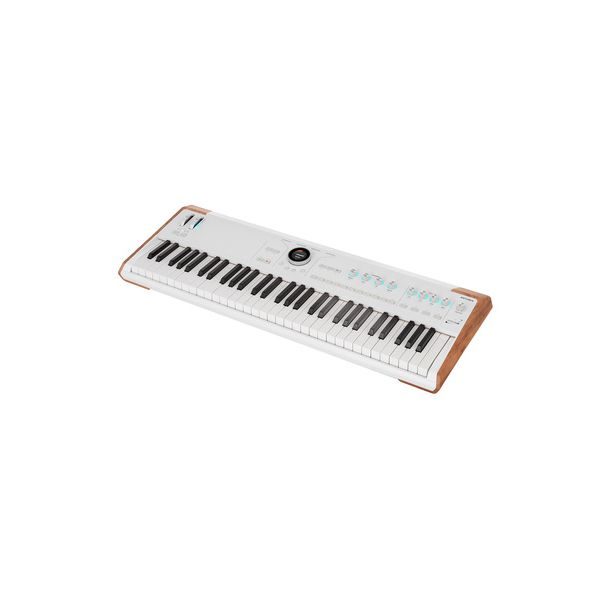
Stage Keyboard
- 61 Semi-gewogen toetsen in standaardformaat
- Voor muzikanten, producers en Live-artiesten die thuis of in de studio Sounds willen gebruiken, voorbereiden op podiumoptredens of gewoon willen integreren
- 10 Sound Engines: Virtueel Analog, Samples, Wavetable, FM, Granular, Physical Modelling, Vector Synthesis, Harmonic, Phase Distortion, Vocoder
- Meer dan 1.300 geïntegreerde Sounds
- Meer dan 10.000 Sounds via Arturia-software
- Arpeggiator
- Looper
- Chord en Scale modi
- Navigation Wheel en scherm om eenvoudig te navigeren
- 10 Preset knoppen voor een snelle toegang tot de Sounds
- 4 Macro controls
- 17 Insert FX en dedicated Delay/Reverb
- 4 Toegewezen draaiknoppen om de effecten te regelen
- Multi en Keyboard Split functie
- Bluetooth Audio en WiFi om draadloos te bedienen
- Input Gain control
- Pitch Bend en Modulation wheel
- Octaafschakelaar
- Compatibel met V Collection en Pigments (niet inbegrepen bij de levering)
- Incl. AstroLab Connect (iOS + Android) en Arturia Analog Lab Pro software (download), Quickstart gids, registratiekaart, USB-kabel (C/A), gebruiksaanwijzing en netadapter
- Afmetingen (B x H x D): 935 x 99 x 330 mm
- Gewicht: 9,9 kg
Aansluitingen:
- 2 Combo-ingangen Mic/Line/Instrument: XLR/jack
- 1 Sustain-pedaal ingang: 6,3 mm jack
- 1 Expression-pedaal ingang: 6,3 mm jack
- 2 Aux pedaal ingangen voor Switch pedalen met Continuous functie: 6,3 mm jack
- 1 MIDI-ingang: 5-pins DIN
- 1 MIDI-uitgang: 5-pins DIN
- 2 Line-uitgangen: 6,3 mm jack
- 1 Stereo hoofdtelefoonuitgang: 6,3 mm jack
- USB-A (host) en USB-C-aansluiting en stroomaansluiting
-
Leverbaar sinds April 2024
-
artikelnummer 591742
-
verkoopseenheid 1 stuk
-
Number Of Keys 61
-
Touch-Sensitive Yes
-
Aftertouch Yes
-
Split Zones Yes
-
Modulation Wheel Yes
-
Number of simultaneous Voices 48
-
Sound Engine Digital
-
MIDI interface 1x In, 1x Out
-
Storage Medium Internal
-
USB-port Yes
-
Effects Yes
-
Arpeggiator Yes
-
Number of Analog Outputs 3
-
Digital Output Yes
-
Display Yes
-
Amount Of Keys 61
-
Touch Sensitive Yes
-
Number of Voices 48
-
Sampler Yes
-
Number of analog outputs 3
-
Pedal Connections Yes
-
Dimensions 935 x 99 x 330mm
-
Pedal Connectors Yes
-
Weight 9,9 kg
-
Optional Expansion Boards n/a
-
Dimensions in mm 935 x 99 x 330mm
-
Weight in kg 9,9 kg
-
A world of classic synths
The AstroLab brings Arturia's extensive V Collection of classic software instruments into a single, dedicated stage-ready keyboard. Fully standalone, it runs a local version of Analog Lab – Arturia's premium performance-oriented software – placing over 44 premium modelled instrument engines drawn from the V Collection at the player's fingertips without requiring a computer. A 61-note semi-weighted keyboard with aftertouch, modulation and pitch-bend wheels, and other performance-enhancing tools underlines its focus on real-time control rather than menu-driven programming. At the same time, AstroLab remains closely tied to its software ecosystem: Sounds can be developed in depth within Analog Lab or the V Collection and transferred to the hardware, where they operate as a cohesive, self-contained instrument ready for the stage. In essence, AstroLab is the live-performance extension of the V Collection.

)
Performance architecture and sound control
AstroLab is bi-timbral, organising sounds into Single or dual-layer Presets that can be split or layered across the keyboard with independent levels and transposition. A large central rotary encoder with a clear colour display enables fast preset navigation, supported by dedicated transport and other performance buttons. Eight assignable rotary knobs provide hands-on access to instrument macros – such as modulation, brightness, and timbre – as well as effects including inserts, delay, reverb, and EQ. An onboard arpeggiator, chord and scale modes, and a MIDI looper complete the performance architecture, extending creative control well beyond static presets and reinforcing its role as a fully-fledged performance instrument.
)
Built for the working keyboardist
AstroLab is aimed squarely at keyboard players who need immediate access to a broad, professional sound palette in a dependable, laptop-less, stage-ready format. Touring musicians, session players, and band keyboardists can cover piano, organ, analogue, and digital synth roles from a single instrument. Its bi-timbral design allows flexible splits and layers, while advanced MIDI integration lets it operate as a primary instrument or as part of a larger rig. In the studio, AstroLab transitions naturally into DAW environments, functioning as both a sound source and control hub. It bridges performance and production without forcing musicians to change instruments, sounds, or their working methods.
Connectivity and ecosystem
AstroLab is designed to operate as part of a broader setup without becoming dependent on one. True to its software heritage, it integrates seamlessly into DAW-based environments. Its USB-C connection functions as both an audio interface and a MIDI controller, while two XLR/TRS combo inputs with gain control allow microphones, guitars, or line-level sources to be routed through the AstroLab for processing, or into a wider DAW setup. Standard 5-pin MIDI In/Out and multiple pedal inputs make it easy to expand a live rig with additional keyboards, sound modules, or other sources. Bluetooth audio streaming and Wi-Fi connectivity simplify playback and wireless management, while the dedicated AstroLab Connect app enables mobile sound organisation and preset transfer. This studio-to-stage continuity ensures consistent workflow and sound identity between production and performance environments.
)
About Arturia
Arturia's success story began with software emulations of well-known analogue synthesizers such as the Moog Minimoog, Sequential Prophet-5, and Oberheim SEM. The popular software instruments included in the V Collection are still flagship products of the French developer today. Over time, Arturia has gradually expanded its range and now also offers a host of hardware devices, ranging from synthesizers and keyboard controllers to sequencers. Since then, the former software developer has thus also become a household name in the world of analogue synthesizers and other equipment.
)
The V Collection – centre stage
Arturia's AstroLab ships with over 1800 curated presets drawn from Arturia's V Collection of virtual instruments, spanning Moog-style analogue synths, DX7-inspired FM tones, Hammond organ emulations, electric pianos, orchestral textures, and modern engines such as Pigments. When combined with additional sound banks and deeper editing via Analog Lab and the V Collection, its sonic scope expands even further, bringing decades of keyboard history and advanced synthesis into a single performance instrument. Bi-timbral splits and layers allow contrasting sounds – organ and monosynth, electric piano and strings – to coexist effortlessly without external modules or laptops. Add the arpeggiator, chord and scale modes, and the MIDI looper, and the result is a compact stage unit capable of replacing an entire multi-keyboard rig.
Accessoires & verwante producten

Vergelijk opties
-
Arturia synthesizer in een oogopslag
-
synthesizer in de prijscategorie van 1000 € - 1500 € weergeven
-
naar productgroep synthesizer
-
naar productgroep workstations
-
naar productgroep synthesizer
-
naar productgroep Toetseninstrumenten
-
toon fabrikant details voor Arturia
-
Arturia Toetseninstrumenten in een oogopslag